Showing posts with label Francis Bacon. Show all posts

Friday, 1 December 2017

43.READING & BOOKS


43.READING & BOOKS


Image credit:greatbooksacademy.org

Reading maketh a man!

Reading good books is the chief pleasure of cultivated minds. It is indeed  the prime mark of a civilized man.


"Reading maketh a full man; conference a ready man; and writing an exact man", said Francis Bacon.

 Reading good books connects us with the great minds of the world.It brings us in touch with our own selves. All other forms of entertainment lead us away from our core selves- make the mind flow out into phenomena of the outer world. A great book touches our inner core. It leads us into ourselves. It opens up an inner world of thoughts and reflection.

What are great books?
.
It is as difficult to define a good or great book,as it is to define a cow.  We can understand it only  when we have read a lot. It is here we are guided by the experience and knowledge of responsible elders. Every society and its institutions have valued certain books as expressing best  the foundations of their culture and civilization. In the West, this is spoken of as the Western Canon, or the  Great Books of the Western World. These are essentially books that have stood the test of time, untouched by the modern 'bestseller' fad.

An educated person was expected to  have a broad idea of the basic features of his own cultural traditions.Educational systems and arrangements were designed to serve this purpose.Great books aided this task. But education is now equated with institutional schooling/university studies which have their own agenda and logic. Their main characteristic is rising, narrow specialisation of academic disciplines.They are designed to lead to a job or career. A product of such academic circus is unlikely to know much, if anything, beyond his own narrow field. This trend was noticed  in the US even in the 20s of the last century. It has only spread and strengthened since then.

Great Books program


Some educators in the US compiled lists of books considered great. Mortimer Adler compiled a list of over 500 books. There are other lists containing 100 or 150 books. 
Right: Dr.Mortimer Adler.
Photo from:consilientinterest.com

Adler gave three criteria to judge a book as great:
- it should be such as can be read repeatedly
- it should have relevance to contemporary problems
-it should reflect the interests and concerns of a large number of the thinking minds of the past centuries.
Based on these, they developed Great Books Program as a curriculum to be taught in the universities.


According to Wikipedia,  over 100 institutions in the US, Canada and Europe still run such a program as an academic option. However most big universities do not have  a regular program, though they teach courses in 'humanities' under which head literature and philosophy are now included.But these do not necessarily cover the great books.

The Classics


Cover of a book by Louise Cowas and Os Guinness. Baker Books.1998

The Western academic circles were , in the past, proud of their"classics"- bedrock of books providing their basic ideas: the Greek epics ,Greco-Roman philosophy and drama, the great literary works, history , etc. Their study formed the foundation of a well-rounded education. However with the rise of the military-industrial society,and modern technical 'culture', study of humanities has declined in importance, and people at large have lost the connect with the classics. Only the specialist students and the  
diehard enthusiasts  still read the classics.

Antagonistic universities

In fact, the  attitude of mainline  academic institutions  in the West is antagonistic to the study of their own Classics. Under leftist and other modernist political- theoretical influences,which have invaded them, they are deprecating their classical literature,[ and devaluing their whole cultural heritage as the product of a dead white male superiority offensive.] This is supposed to be the "politically correct" stance. As Elizabeth Kantor notes:
"Enroll in an English class at an American university, and you might find yourself studying Marxist theory, or the history of ballet. You could be treated to an investigation of pornography through the ages. Or you might spend the semester watching foreign films. What is far too unlikely to happen is that you will be taught to understand and appreciate great literature in the English language.
"These days the English professors seem to be teaching anything and everything but classic English literature - from "gender theory" to Freud to "Latino/a popular culture." PC English professors are busy replacing the "dead white males"of the traditional literary canon with the authors of '80s bestsellers that hit all the politically correct themes. Departments of English are staffed by professors dedicated to suppressing English literature, not teaching it."


Cover of a book challenging the 'politically correct' attitudes.
Regnery Publishing, Inc.2006.


However, it is not without its challengers, but such challenge takes place largely outside the big universities where  thousands of students are indoctrinated in the current  official line year after year. Majority of the students do not have a proper exposure to the ideas of their own great men of letters. It is indeed strange that in a so called "free" country like the US, young minds are enslaved to some officially upheld theories and dogma in the name of education. It is unfortunate.

Value of great books

 A reviewer (Raymond Matthew Wray) of the  'Invitation To The Classics' noted:
.... the greatest benefactors of a great book curriculum will be the young. We should do our utmost, Socrates tells his interlocutors, that the first stories that they hear should be so composed as to bring the fairest lessons of virtue to their ears. Ironically, Socrates would have censored Homer's tales. Nevertheless, he understood the importance of introducing young students to right thinking. With the proper guidance, reading the primary texts allows for the student to engage the raw ideas on their own terms. What emerges are the critical thinking skills that give rise to the constituents needed in the formation of character, which is crucial both to citizenship and civility. However, there is something more important than citizenship and civility (dare we say it?): the state of the student's soul. Through reading, children can draw on the heritage of our progenitors and forge the framework of a virtuous life.
The great books provide a venue for us to explore the human experience without the risk of being all-too-human, to develop character through characters. They are the life we may never live; they are the people we may never meet. Through encounters with them we can engage the ideas we may never have. These are the forces that expand our inner world, making the world around us more meaningful. This is the experience students are being denied across the nation from colleges and universities. This is the very experience Louise Cowan and Os Guinness invite us to share. 
www.catholiceducation.org.1999
This sums up the matter well.

India: ignorance is bliss!

In India, we were spared the pain or pleasure of learning our classics by the colonial  education system imposed by Macaulay in 1836.  Indian traditional learning was bypassed, Indian subjects and themes were dropped, and youngsters were induced to take to the new system by the trick of linking English education with jobs! Even so, traditional systems prevailed in truncated forms in isolated pockets. During the course of our freedom struggle, all the national leaders were deeply attached to the national roots, though English had become the language of  communication among the educated. But the deeper maladies were not addressed: our national literature was neglected, our  history was distorted to suit the colonial powers, our children were made to learn not only English as a language, but English ideas, manners and alien history.
The problem became more acute after Independence. The idea of 'nation' came to be defined in the narrow political sense; political interests took over. The creation of linguistic states unleashed forces of provincial chauvinism based on language. The country has been divided by narrow linguistic walls. The central govt. is substituting Hindi imperialism for Macaulay's English imperialism. The cumulative result is that the idea of national culture has receded from the public consciousness.

Our educational system was taken over by leftist elements . The history of India is taught as interpreted by Marxists. The result very much resembles what prevails in the US: the tendency is to deny the value of our own sources and fields of knowledge,  deprecate the roots and fruits of our own civilization, decry or deny the greatness of our own heroes! The story of invaders- the Muslims and Europeans- is taught as the history of India! They are shown as our saviours and modernisers! Thanks to Macaulay, whose system still prevails in tact, our students are more exposed to English and foreign  literature and literary figures than to our own. But these are not taught systematically- it is like a patchwork quilt. They are out on a limbo- they neither master the foreign stuff nor learn about their own  achievements! They stand alienated from their own roots.


Great literature is more than literature!

In studying the great literature of the past, we learn more than the literature. We learn about life through the literature. We learn how life was lived, viewed and experienced by past generations. We learn of their achievements and failures, their problems and frustrations, their greatness and limitations. We acquire an attitude to life and its problems. We learn to look into ourselves and examine our motives, ideas, desires which are at the base of human action and reaction in all societies at all times.  All great literature propels us inward, to undertake the hardest of all enterprises- knowing ourselves!  It puts us in touch with ourselves. Great literature- "where courage and cowardice, love and hate, death and justice and joy, all spring to life through the words of great writers"   ( in the words of Prof. David Allen White), and through the actions of the characters- has a civilizing influence on us. No one who studies the great Greek epics- The Iliad and the Odyssey, or our own Itihasa - The Ramayana and The Mahabharata, can remain the same afterwards.When we read the ancient Greek philosophers or our own Upanishads and Darshanas, we are struck by the nature and magnitude of the questions they grappled with! And we also realise that in spite of the lapse of millennia, these questions are still with us! The reading of the epics reveals to us that human nature has hardly changed! Thus old, classical literature has proved timeless! After all, it is these same basic motives and themes that are still portrayed through movie and TV!


Great literature humanises us, elevates us, almost in spite of ourselves! 
William Faulkner said in his 1950 Nobel Prize acceptance speech:

I believe that man will not merely endure: he will prevail. He is immortal, not because he alone among creatures has an inexhaustible voice, but because he has a soul, a spirit capable of compassion and sacrifice and endurance. The poet's, the writer's duty is to write about these things. It is his privilege to help man endure by lifting his heart, by reminding him of the courage and honor and hope and pride and compassion and pity and sacrifice which have been the glory of his past.

Disservice by the universities

Our blasted modern universities are denying our youngsters opportunities to  learn  about those instincts and emotions, attitudes and ideas, forces of character and  courage that led their forebears  to face well or ill the problems of their times. Which problems are still with us ! Instead, the youngsters are taught pet and fancy theories which are here today, gone tomorrow, displaced by a newer fancy! They are all untried opinions "dispensing absinthe morality." Great literature, of all times and peoples, deals with the basic problems of the human condition- what it means to be human, and live in the world -and hence it is timeless.It is also 'borderless' in the sense that it touches some values which have universal validity, even if clothed in local colour, and expressed in local language.  No theories can take the place of the act of reading  and experiencing it for ourselves.
Modern writings provide momentary excitement, but little of lasting value. They tickle our senses but leave the soul untouched. They are well crafted, but there is little true art in them. Great literature of the past slows us down deliberately and thus calms us and exerts a sobering influence. It makes us pause and reflect.

Illiteracy- no bar to appreciation

In the pre-modern days, people were largely illiterate. But that did not stand in the way of their appreciating the great literary works of the past. Epics like The Iliad were recited, accompanied by music. Even in the 19th century England, there were large sections of people who were not literate. But we are told that as and when instalments of the novels of Charles Dickens came out, illiterate people gathered in the pubs to listen to their reading !  That is how the great works reached the common man. He did not have to go to a darned university to learn them.

 This is a tradition which still survives in India : our great Itihasas and puranas like the Bhagavatam are still recited , at times to huge audiences in North India.  The popular entertainment through cinema and now  the TV has killed many forms of indigenous cultural education and entertainment, but the tradition of oral recital of our great works continues.


Morari Bapu  addressing a  gathering in London on "Ram Katha"- August, 2017.

“Katha is not a religious gathering; it is a conversation about life.”

MORARI BAPU

Pedagogues  and politicians alike propagate literacy in the name of education but the products so raised usually end up reading nothing higher  than the newspaper, magazines and cheap fiction. This is the mark of what goes on in the name of mass education.

Printed book & its competitors

Since the invention of printing, learning has mainly been through printed books.This led to the spread of literacy. However, it  has not led to people reading great literature.
 Literacy is now computer literacy leading to "digital natives". Modern developments like e-books,  digital books, Kindle, tablets etc seek to displace the physical books. But researchers tell us that they are really no substitute for the experience of reading the physical book. A report in the Scientific American in 2013 said:


"...... evidence from laboratory experiments, polls and consumer reports indicates that modern screens and e-readers fail to adequately recreate certain tactile experiences of reading on paper that many people miss and, more importantly, prevent people from navigating long texts in an intuitive and satisfying way. In turn, such navigational difficulties may subtly inhibit reading comprehension. Compared with paper, screens may also drain more of our mental resources while we are reading and make it a little harder to remember what we read when we are done."
"In most cases, paper books have more obvious topography than onscreen text. An open paperback presents a reader with two clearly defined domains—the left and right pages—and a total of eight corners with which to orient oneself. A reader can focus on a single page of a paper book without losing sight of the whole text: one can see where the book begins and ends and where one page is in relation to those borders. One can even feel the thickness of the pages read in one hand and pages to be read in the other. Turning the pages of a paper book is like leaving one footprint after another on the trail—there's a rhythm to it and a visible record of how far one has traveled. All these features not only make text in a paper book easily navigable, they also make it easier to form a coherent mental map of the text."
[www.scientificamerican.com. Ferris Jabr. April 11, 2013]
There are really no substitutes for the physical book. 


Let us read the Classics

We usuallly read something or other- newspaper, magazines, etc. If we cut down on such frivolous reading, we will surely find time to read some classics- our own classics, too. Over the years, it will become a good habit. If we cut down on some spending in other areas, we can surely find money to buy our own books and can build a home library. While buying, we should avoid the temptation to buy 'mass market paperbacks'. They may be cheap, but they are cheap in quality also, and do not last.We have to buy more durable editions- in which the sections are stitched, not just glued. If we view books as life long investment, we will choose quality publications. In the metros, we usually get good used books at reasonable price.


 "The mind is not an empty vessel to be filled, but a fire to be kindled.”  
Plutarch, ancient historian.

Note:
As for the classics, it is better to buy an edition which contains introduction and notes. The introduction is usually provided by learned scholars who have devoted a lifetime to their study and reflection. The notes explain difficult terms and references which we cannot easily find in dictionaries. These enhance our pleasure and understanding. We may read them at our own pace, without external compulsions and pressures. We may discuss them with like-minded people - the 'conference' as said by Bacon! Thus will our real education begin and continue after we leave the blessed school or college!



Wednesday, 3 May 2017

22.EDUCATION AS HUMBUG


22.EDUCATION AS HUMBUG


picovico.com/business/education

Education/ Learning has been highly valued in all societies since ancient times. But it was not always equated with or mistaken for mere literacy and a paper degree as in modern times. Education precedes invention of writing, just as books precede the invention of printing.

Education: old systems

The main purpose of education in ancient times was the cultivation of character. To this end, the subjects taught were religious lore, histories of the people, their philosophy and mythology. The main role of education was to preserve and pass on the culture to the next generations, on which they could build. In the history of every people there were some remarkable men and periods during which education especially advanced. An educated person was necessarily a cultured person. The education which informed the mind also helped form character. Arunagirinatha says this tellingly in Tamil:
மதியால் வித்தகனாகி மனதால் உத்தமனாகி
which can be roughly rendered as 'enlightened in mind and noble at heart'.


Learning was mostly informal, as the education necessary for most occupations was imparted while learning the trade or craft which were mostly inherited. This we can see in India even today in certain branches. The fine arts of music and dance modern universities may teach and certify. But the real concert artistes are those who have learned the art from a personal teacher (guru) in the traditional way. The greatest names in our classical music never attended a music college.
The same can be said of temple architecture. Even today, these artists/engineers [ traditional stapatis ] imbibe the technique and the necessary theoretical knowledge from personal teachers in the traditional way. Not a single one of the modern engineers churned out by the mushrooming engineering colleges anywhere in the world can erect a temple like that. Ayurveda, the Indian system of medicine was also taught in this manner till recently.

In the ancient world, learning concentrated on language (grammar), effective speech (rhetoric), correct thinking (logic), law, and philosophy which included natural sciences in the name of natural philosophy. It also included learning the old mythologies and epics, which dealt with basic truths in the form of allegorical stories. Most books on any subject were in verse. It required precision in presentation and ensured ease in learning (memorisation).

Indian Experience

India was noted for vast learning since ancient times. However, so called modern western academics and following them our own copycats do not provide a proper picture. For instance, the coverage in Wikipedia which generally advocates a pro-western view gives some absurdities. It states that the Vedic Age was from 1500 to 600 BC. It says it was a pre-Hindu tradition.  Only an imbecile or intentional liar can be capable of such distilled nonsense in the light of available evidence and living tradition. It was  Max Mueller, who could not follow spoken   Sanskrit, nor  had learned the Vedas properly, who first stated some such date arbitrarily; but when challenged by more competent scholars, he said no one could fix the date of the Veda. For understanding  these matters clearly, one should study the talks of  former Pontiff of Kanchi Shankara Mutt and the works of Sri Aurobindo.

Vedic study

Before the invention of printing, learning was mainly oral. This automatically ensured that only the serious aspirant could enter and persist in the field. And it also indicates why they gave so much importance to language. For instance, Veda only means "knowledge or wisdom". It could not be confined to  or equated with any book. Even now it is transmitted orally. This is accomplished without distortion of the sound, due to the rigorous methods followed to fix the sounds. In this , the learning of the Veda is accompanied by six hard disciplines:

  • Siksha            = phonetics
  • Chhandas       =  prosody
  • Vyakararana   =  grammar
  • Nirukta            = etymology
  • Kalpa              = ritual
  • Jyotisha          = astronomy
These are known as Vedangas- limbs of the Veda. It takes  a minimum of twelve years to learn these, and upwards of twenty five years to attain real competence. It involves full time study and reflection, accompanied by disciplines of body and mind.

Though initially connected with the Veda, these systems of study and analysis are now adapted to many other disciplines. Sanskrit is a very unique language, and the meaning of its words cannot be fixed by a dictionary in hurry. Besides, Veda is not  in Sanskrit, as the classicists know and study it. Vedic language is special.That is why a Max Mueller or his grandfather ( or grandson, for that matter ) cannot fix the meaning of Vedic expressions. On this, one should study the writings of Sri Aurobindo. [ The Secret of the Veda; Hymns to the Mystic Fire.]

Six Darsanas

Following and accepting the authority of the Veda, sages propounded six approaches to understand Reality, [astika darsanas] which are known as six systems of philosophy though the word philosophy is not correct. 

  • Sankhya        = matter and consciousness
  • Yoga              = Unity of existence ( Yoga means union, which                                      implies 'viyoga' or separation. So the                                           effort is to   seek unity through control of                                     mind, meditation etc)
  • Nyaya            = Logical analysis of the sources of knowledge
  • Vaishesika       = Atomism- analysis into basic units
  • Purva Mimamsa = ritualism, based on Vedic authority 
  • Uttara Mimamsa or Vedanta  = Experiential knowledge of the                                                      Absolute, Non-dual Reality.


Due to the fertile Indian mind, and the creative freedom it had in matters of faith, each one of these developed subdivisions in course of time. The really learned do not see them as competing systems, but as complementary steps in the path of spiritual effort and realisation, suiting the unique competence and meeting the specific needs of each aspirant.
 For instance, Nyaya or logic is used by all systems!  The Yama and Niyama propounded by Patanjali's Yoga form the basis of ethics and morality.The practical discipline involved is almost the same in all systems! [ Those interested should study them through authentic Indian sources and not through the works of  vain western academics.]

Before the British


Priests had to be learned in the religious ceremonial rules, and it was hereditary. But anyone could learn other subjects, including religious subjects. Just look at the sheer number of saints and sages who do not come from the orthodox Veda-learning sections. Till the Macaulay system was imposed on India, we had a fine system of indigenous education which served all communities.


 Mahatma Gandhi called it a ''beautiful tree". 
Dharampal has written a beautiful book with that title. ( The Other India Press, Mapusa, Goa.) It deals with the state of Indian education in the 18th century.
 Gandhiji said in this connection:


 I say without fear of my figures being challenged successfully, that today India is more illiterate than it was fifty or a hundred years ago, and so is Burma, because the British administrators, when they came to India, instead of taking hold of things as they were, began to root them out. They scratched the soil and began to look at the root, and left the root like that, and the beautiful tree perished. The village schools were not good enough for the British administrator, so he came out with his programme. Every school must have so much paraphernalia, building, and so forth. Well, there were no such schools at all. There are statistics left by a British administrator which show that, in places where they have carried out a survey, ancient schools have gone by the board, because there was no recognition for these schools, and the schools established after the European pattern were too expensive for the people, and therefore they could not possibly overtake the thing. I defy anybody to fulfill a programme of compulsory primary education of these masses inside of a century. This very poor country of mine is ill able to sustain such an expensive method of education. Our state would revive the old village schoolmaster and dot every village with a school both for boys and girls.

(MAHATMA GANDHI AT CHATHAM HOUSE, LONDON, OCTOBER 20, 1931) 
[ Incidentally, so called school education has become even more expensive- atrociously and unconscionably so- in Independent India.]


Cover of the Biblia Impex edition.


The British   ignored the indigenous system, imposed European-centred education, imposed English as the language and made its knowledge compulsory for jobs! Thus with one stroke, they made India poor in education, and made education expensive! As the old economic arrangements were also changed by the British, education in Indian knowledge systems became irrelevant for earning a livelihood, by the mere logic of events. These trends continue even today. Our own Indian govt has imposed Hindi imperialism . And the primary motive of this kind of formal schooling [ it cannot be called 'education'] is to get a job! But it does not ensure even that, as more than 50% of Indian graduates are reportedly found unemployable.


onlinelearninginsights.wordpress.com


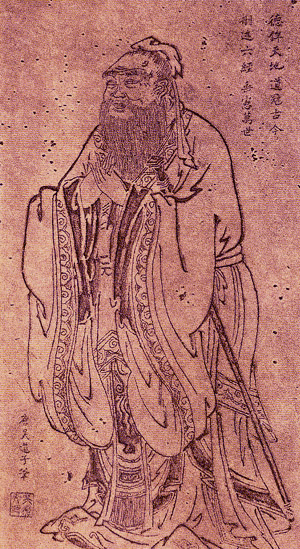
Confucius and Analects


Not that education was not needed for bureaucrats, or general business or in other walks of life. We learn how in China, the  ideas of Confucius  became the basis for training bureaucrats. But they also recognised other aims. Confucius was training bureaucrats two centuries before Plato established his Academy in Athens. The core of his teaching was cultivation of "virtue" which involved piety, reverence leading to a harmonious society. Though born human, we become a person only by fulfilling a responsible role in society and for that cultivation of virtue is essential, not the mere obedience of laws. Confucius said in his Analects:


If people be led by laws, and uniformity  sought to be given them by punishments, they will try to avoid the punishment, but have no sense of shame.
If they be led by virtue, and uniformity sought to be given them by the rules of propriety, they will have the sense of shame, and moreover will become good.

The superior man thinks of virtue; the small man thinks of comfort. The mind of the superior man is conversant with righteousness; the mind of the mean man is conversant with gain.

Thus, we can see that noble minds have been concerned with virtue and righteousness even while training people for political offices. The Greeks and the Romans too held that while happiness was the aim of human life, it was the result of Virtue. In India, this sentiment is expressed in the concept of 'Dharma'. 

Modern trends

All this is a far cry from what modern schooling and colleging  aim at and provide in the name of mass education!

Both the aims and the contents of what is considered education have changed over the centuries. We now have so many 'subjects' and any number of areas for specialisation in each. PHD is the stamp of official approval on the highest level of university education, but it can be on any subject approved by authorities ie those who control the funding and confer the degree. 

Since the early 19th century, "the three r's " - reading, writing, arithmetic- were considered the basic skills to be imparted to  every youngster. They were supplemented by Classics- languages like Greek and Latin and the works of ancient masters. In the last century, education was reformed and modernised. In spite of such efforts, we now have lakhs of school-going Johnnies who cannot read or add!

Tiruvalluvar on education

Tamil poet Tiruvalluvar laid down his definition of education :

கற்க கசடறக் கற்பவை கற்றபின்
நிற்க அதற்குத் தக.                               391

Learn what knowledge is required to be acquired.
Thereafter, conduct your life accordingly.

But what is to be acquired?


எண்ணென்ப ஏனை எழுத்தென்ப  இவ்விரண்டும்
கண்ணென்ப வாழும் உயிர்க்கு.            392

Two are called the eyes of the living: one is called Numbers; the other is called Letters.

கண்ணுடையார் என்பவர் கற்றோர்  முகத்திரண்டு
புண்ணுடையர் கல்லா தவர்.                 393

The learned alone can be said to possess eyes.
The uneducated have only two sores in their face.

ஒருமைக்கண் தாம் கற்ற கல்வி ஒருவர்க்கு
எழுமையும் ஏமாப் புடைத்து.               398

The learning that one acquires in this birth will exalt him in the subsequent seven births.

கேடில் விழுச்செல்வம் கல்வி  ஒருவற்கு
மாடல்ல மற்ற யவை.                         400.

A flawless and imperishable  wealth is the learning one acquires. Others are not wealth at all.

Education and seven births

Here in verse 398, Tiruvalluvar provides serious food for thought. Indian philosophy  and religion are based on rebirth. What merit or demerit one acquires in this birth- his own effort now, here- will shape his future births. The education he acquires now will also influence his future births. This probably accounts for the phenomenon of child prodigies. But will any kind of learning or subject so accompany one for seven births? To day we have hundreds of subjects of specialisation. Are they all relevant for rebirth? Yesterday's Newtonian physics is superseded today. Every branch of science is undergoing such drastic changes. Will they not become irrelevant in the centuries to come? This is the fate of all secular subjects.The kinds of learning that will influence us in future births are what are called the 'eternal verities'- related to the unchanging core of human nature,  the fundamental truths of classical philosophy and religious studies, and not the hundreds of secular subjects, or the speculations of modern philosophers and scientists. This really explains why education was considered 'sacred'. In this one respect, Indian traditional wisdom scores over everything else in the world! However, modern India has already lost sight of this truth.

Reading, conference, writing


In the background of the formal education that prevailed in the 16th/17th centuries, Francis Bacon, contemporary of Shakespeare said:


Reading maketh a full man;
conference a ready man;
and writing an exact man.


Since those times, each of these propositions has become difficult of fulfilment.  Millions of books are in existence, millions more are getting published every year. What to read? Where is the time in these hurly burly days? Even if one is a dedicated practising professional like a lawyer or medical doctor, one cannot hope to fully cope with the new material available. It is said that a research paper in a subject is read by just 3 persons on the average. C.P.Snow said that scientists do not follow the language of humanities, and those in the humanities do not follow the language of science. Smithsonian.com notes:


There are a lot of scientific papers out there. One estimate puts the count at 1.8 million articles published each year, in about 28,000 journals. Who actually reads those papers? According to one 2007 study, not many people: half of academic papers are read only by their authors and journal editors, the study's authors write. 

[Report dated:  March 25, 2014.      Accessed 3 May 2017.]


 So, what can be said of general readership? Most people test their literacy only against newspapers, that too by just skimming it! 

Modern technology has reduced the charm and power of learned conversation. People do not even discuss the weather or politics or cinema. Cell phone, Internet, Facebook etc have killed all meaningful and pleasant conversation.

In the era of instant wireless communication, who writes anything, unless compelled?

It is the absence of all three that is the norm today, especially among youngsters. Almost every youngster is looking into and talking on his cell phone while walking on the road.He doesn't give way to children, seniors. He doesn't address  others properly. Such misbehaviour is a worldwide phenomenon.


Sulking, arguing, lying, and rebelling are just a few of the ways teens misbehave. There's a good explanation for these bad behaviors. As teens become more independent, they still lack the emotional maturity they need to make informed, thoughtful decisions. The parts of the brain that control decision making and impulse control haven't fully developed. The combination of autonomy and immaturity can lead to risky teen behaviors, like drinking, smoking, and having unprotected sex.

[webmd.com  Accessed: 3 May 2017]


A growing lack of adult authority has bred a 'spoilt generation' of children who believe grown-ups must earn their respect, a leading psychologist has warned.
The rise of the 'little emperor' spans the class divide and is fuelling ills from childhood obesity to teenage pregnancy, Aric Sigman's research shows.
Attempts to 'empower' children and a lack of discipline in the classroom have also fostered rising levels of violence, at home, at school and in the street.

dailymail.co.uk. 14 September 2009.

Do we call such 'schooled' youngsters 'educated'?
Traditional education fostered respect for authority, and stressed responsible behaviour. Today, teachers can't discipline the students, nor can parents; such attempts will be construed as violation of some rights!

Education: for what purpose?

With all the hype about modern education, and the hole it puts in the hearts and pockets of parents, there is no clarity as to even the very purpose of education:


What is the purpose of education? The question came into stark relief when Wisconsin Gov. Scott Walker recently tried to quietly change the century-old mission of the University of Wisconsin system by proposing to remove words in the state code that command the university to “search for truth” and "improve the  human condition” and replacing them with “meet the state’s workforce needs.” Walker backed off when the issue became public and sparked intense criticism from academics and others, but the issue remains a topic of national debate 


By Arthur H. Camins
Debate about the purposes of education never seems to end.  Should young people become educated to get prepared to enter the workforce, or should the purpose of education be focused more on social, academic, cultural and intellectual development so that students can grow up to be engaged citizens?
[ Washington Post:  February 12, 2015 ]

Should we not simply say the purpose of education is to make us better human beings , and modern education has failed in this mission? Man is missing in all schemes of modern education!
It was Swami Vivekananda who talked of 'man-making' education!


www,gettingbusy.ch/category/education