Showing posts with label Sri Aurobindo. Show all posts

Tuesday, 27 June 2017

29. INDIA,, THE MOTHER !


29. INDIA, THE MOTHER!

WHY should we love the motherland? What does it involve?

Patriotism V. Nationalism


Usually we speak of patriotism or nationalism. But both words do not mean the same thing. George Orwell explained  patriotism and distinguished it from nationalism in a famous passage:


"By 'patriotism' I mean devotion to a particular place and a particular way of life, which one believes to be the best in the world but has no wish to force upon other people. Patriotism is of its nature defensive, both militarily and culturally. Nationalism, on the other hand, is inseparable from the desire for power. The abiding purpose of every nationalist is to secure more power and more prestige, not for himself but for the nation or other unit in which he has chosen to sink his own individuality." 

[ From: Notes on Nationalism, 1945 ]


He has clearly brought out the essence of patriotism- devotion to a place and its culture, defensive militarily and culturally.

Mother and Motherland

This was beautifully stated millennia ago in a few words by Rama in the Ramayana. After the battle is over, Vibhishana invites Rama and company to enter Lanka and spend a few days. Rama  declines the invitation and utters words which will remain immortal:


"Janani Janma-bhoomi-scha Swargadapi Gariyasi" 

 जननी जन्मभूमिश्च स्वर्गादपि गरीयसी

Mother and motherland are superior to  even heaven!


It is  the national motto of Nepal! 


World as home?

There are many who would consider such sentiment to be pure jingoism or chauvinism. But why should it be so? Is not a normal person attached to his/her mother? Is not the bond with the mother something special? Does it imply dislike or hatred of others?

Many people today would say, sincerely, that they are above such low and limiting notions, that the whole of humanity is one, that they are citizens of the world, the world is their home. This is indeed a noble sentiment and high ideal. But is humanity ready for it, really? How many countries would welcome you, and let you remain as you are, there? Will you continue to be welcome in case hostilities break out between the two countries? Why do countries have Visa regulations and continue to tighten them?

And within modern India how many states will welcome you if you speak a different language? They just suffer you!

Leave  the world alone. Take the European Union. It is remarkable that countries which were traditional enemies and fought many wars came together in some arrangement. But do the people of  those countries  feel emotional and cultural unity, apart from economic and political interests? Do they feel like one people? Are the English, the French, the Germans the same or alike? Are they really comfortable with each other? Do they feel Greece is really their equal? Do the Greeks feel so, in turn? Would be citizens of the world, knowing only English, should visit France and Germany and experience what it is like there! After all, they all follow the same religion, at least nominally, even if it is secularisn? Perhaps, only real scholars would be welcome across borders. Even there, modern universities have erected ideological barriers among themselves.  

 The concept of motherland holds something more than all these earthly ideas. Ethnic identity still matters, as the aftermath of the fall of the USSR has shown. There is an invisible chord which binds you with the place of your birth. Who ever left his native place without a lump in the throat? Nationality does mean something- however it may be defined, whatever may be its basis.

There have been violent and ugly manifestations of nationalism in the past. This has happened with every ideology- religion, socialism, democracy, beginning with liberty, equality , fraternity, etc. It does not invalidate   the ideology as such.

Orwell's words imply that there is something more than defence of space: it is defence of culture! And culture has evolved in response to and in the soil of a place! It is not narrow-mindedness to love one's own culture, or nationality any more than it is to eat the food one is accustomed to. It becomes a threat and a problem  only when it leads to a superiority complex and  a hatred of and the urge to  dominate  or eliminate others. It is a problem only if it breeds prejudice.

Aggressive nationalism and peaceful culture

 Unbridled Nationalism, in the service of ambitious politicians, usually leads to  aggressive postures and attitudes, often culminating in war, as we saw in the two world wars. Ethnic nationalism often leads to attempts at genocide. This is due to the Western idea of 'nation' as 
being mainly a political unit- a State. However, the people also constitute a society, and such societies may exist in any State!  [Rome conquered the Greeks, but adopted Hellenistic ideas! Roman youngsters were sent to Athens to study!] In India, Rabindranath Tagore gave expression to it. He talked of society- 'samaja', and not in terms of political nationalism. [Ironically, in contrast to the Romans, India became free of British rule, but has become more Anglicised or Americanised thereafter. Modern Indian education thoroughly de-Indianises everyone.]


Einstein and the French savant Romain Rolland also disliked the idea of nation states and nationalism. However, Einstein felt a deep attachment to his Jewish heritage, though he was not a Zionist, practising Jew or outwardly religious.


If we consider nation as a society, then it becomes a cultural unit/unity sharing common values. Each such society is unique and need not pose a threat to others, so long as there is no intention of one to dominate others. The history of the last two thousand years unfortunately shows that both Christianity and Islam have forced themselves on other people and nations! It is their belief that they alone are the true path and their prophet alone is the true one! How can they let others live in peace, then?

INDIA IS DIFFERENT

But this is not our view. India differs in two vital respects from the rest of the world, especially the West. Nationalism has risen in the West on the concept of Nation-State, a political dispensation.  India has never felt this. We have felt a broad cultural unity, a philosophical unity as the more fundamental value.  Nor do we force our ways on others, or enforce uniformity everywhere.

 Diana Eck , western academic ( with the usual  western prejudices ) and no 'Hindutva' advocate, writes of :

"a particular idea of India  that is shaped not by the modern notion of  a nation-state, but by the extensive and intricate interrelation of  geography and mythology......The fact that the people of ancient India.....gave a single name to the whole of this diverse subcontinent is itself noteworthy. The name is Bharata. ... This is an indigenous name... India like Japan, China, and Greece links its modern identity  with an ancient and continuous civilization."

[India, A Sacred Geography, Harmony Books, 2012. p.45-46]

INDIA, THE MOTHER

Is India then a mere geographical entity? NO, say our scholars and savants. 

India is not a mere congeries of geographical fragments, but a single, though immense organism, filled with the tide of one strong pulsating life from end to end.

-Radha Kumud Mukherjee: Nationalism in Hindu Culture, 1921.

Our highest ideal of love and devotion to our country is to be found in our conception of our land  as Mother....... We addressed our land not merely as ......mother country, but simply as Mother.

This Mother is the spirit of India. This geographical habitat of ours is only the outer body of the Mother. The earth that we tread on is not a mere bit of geographical structure. It is the physical embodiment of the Mother....Our history is the sacred biography of the Mother.


- Bipin Chandra Pal in " The Soul of India."


BANDE MATARAM:
Salutations to the Mother!


That is why Bankim Chandra Chatterjee sang  "Bande Mataram!" He addressed India as Mother, not just mother country!


वन्दे मातरम्
सुजलां सुफलां मलयजशीतलाम्
शस्यशामलां मातरम् ।
शुभ्रज्योत्स्नापुलकितयामिनीं
फुल्लकुसुमितद्रुमदलशोभिनीं
सुहासिनीं सुमधुर भाषिणीं
सुखदां वरदां मातरम् ।। १ ।। वन्दे मातरम् ।

“Vande Mataram!
Sujalam suphalam, malayaja shitalam,
Shasyashyamalam, Mataram! 
Shubhrajyotsna pulakitayaminim,
Phullakusumita drumadala shobhinim,
Suhasinim, sumadhura bhashinim,
Sukhadam, varadam, Mataram! Vande Mataram!


तुमि विद्या, तुमि धर्म
तुमि हृदि, तुमि मर्म
त्वं हि प्राणा: शरीरे
बाहुते तुमि मा शक्ति,
हृदये तुमि मा भक्ति,
तोमारई प्रतिमा गडि
मन्दिरे-मन्दिरे मातरम् ।। ३ ।। वन्दे मातरम् ।

Tumi vidya, tumi dharma,
Tumi hridi, tumi marma,
Tvam hi pranah sharire!

Bahute tumi ma shakti,
Hridaye tumi ma bhakti,
Tomarayipratima gari mandire mandire!
Mataram Vande Mataram!

I bow to thee, Mother
richly watered, richly fruited,
cool with the crops of the harvests,
the Mother!

Thou art knowledge, thou art conduct,
Thou our heart, thou our soul.
For thou art the life in our body,
In the arm thou art might, O Mother,
In the heart, O Mother, thou art love and faith      

It is thy image we raise in every temple.

I bow to thee, O Mother!

Nation has a destiny!


While Tagore was against the ugly aspects of political nationalism, he was aware of the distinct role and destiny each nation carried. He said in his first English speech in India, in Madras, in 1919:


On each race is the duty laid to keep alight its own lamp of mind and its part in the illumination of the world.

Thus each nation has a distinct role to play and it is by being itself, and not by imitation of others, that a nation fulfills itself and its duty to the world community at large. How different this is from the ugly display of aggressive political nationalism!

Bharat Mata Ki Jai !

Before Gandhi entered the political scene, the country was reverberating with the joyous song of Vande Mataram, and the cries of "Bharat Mata Ki Jai ",made famous during the days of Bengal Partition.  How did this song achieve such a status?  How did it capture the hearts of the people? It was not a sudden development. As Diana Eck records:

"  .... we glimpse something essential about the land of India itself. The land, in this vision , is the dismembered and distributed body of Shakti, providing the soil for a strong sense of the translocal belonging.
"Mother" is the name - both powerful and affectionate- by which Hindus call Shakti, be she Kali the frightful or Ganga  the beneficent....it is also the name by which they call the land of India- "Bharat Mata, Mother India."
Seeing India as Mother is both spiritual and geographical. It is grounded in Hindu affection for the land itself.
"Vande Mataram" has been able to take hold so powerfully in modern India not because it was fabricated and instrumentalised in the colonial context by Hindu nationalists old and new, but because of the widespread  associative meanings that have long linked the land and the goddess."  (p.297-299)
 India as Goddess


No Indian leader has brought out the distinct nature of India in modern times as Sri Aurobindo. In very clear words he said:


Mother India is not a piece of earth; she is a Power,  a Godhead.
India is not the earth, rivers and mountains of this land, neither is it a collective name for the inhabitants of this country. India is a living being, as much living as , say, Shiva. India is a Goddess as Shiva is a god. If she likes, she can manifest in human form.
The Soul of India is one and indivisible. India is conscious of her mission in the world.

India is the guru of the nations, the physician of the human soul in its profounder maladies; she is destined once more to new-mould the life of the world and restore the peace of the human spirit.
We now can understand what is the meaning of India, and what it means to love India. It is more than political attachment. How can one who does not subscribe to and bow down to the Mother that is India be  considered an Indian?

Westerners and westernised Indians cannot understand this idea of India- nor can they like it! They fancy to think that India was not a nation before the British invented it!  What utter idiocy! I quote Diana Eck again:

"The resistance to ideas of India's unity is embedded in colonial thought and often in postcolonial thinking as well. Even the many books that address the idea of India in recent times seem to acquiesce to largely Western constructs.

What are some of the ways in which India has seen itself and enacted its regional and pan-regional identities? Political analysts do not touch this question.Postcolonial studies do not reach very deep into the premodern  subsoil of India to inquire whether there have been alternative ways of imagining the complex collectivity of India in a distinctively Indian idiom."

".....geography of this kind is more than a map. It is a three-dimensional sacred landscape. " (p.47,49)


BHARAT MATA

Indians have always considered their land as more than geography. She is Bharat, Bharat Mata. She is Mother, not just Motherland. Mother cannot be changed or exchanged. That is the basis of true love of India. Any one who cannot consider India his or her Mother and bow down in love and reverence is simply not Indian. It is not mere political allegiance that makes one a true Indian.


India is not merely the motherland. She is Mother.

Vande Mataram!


Note:
1.While 'Jana Gana Mana'  of Tagore has been adopted as the National Anthem, it can be seen that it merely celebrates the physical features of the land of India, and lacks the psychological depth and emotional richness of Vande Mataram! Vande Mataram expresses the genius of India.

2. It is good to remember that India attained Independence on  15 August- the birthday of Sri Aurobindo! This is the seal of Divinity on the work of Sri Aurobindo for Indian Independence.

3.Modern Indian Republic is a political mechanism on foreign models. Real India is an Organic , living Entity. 

Friday, 23 June 2017

28. HEROES: SUNLIGHT AND SHADOW


28. HEROES: SUNLIGHT AND SHADOW


History as commonly taught and understood celebrates the hero. Alexander and  Caesar are the heroes of ancient history, universally admired. Then we have Napoleon , the founding fathers of the United States of America, Abraham Lincoln, Churchill and  Franklin Roosevelt. Hitler, Lenin, Stalin, Mao - they were also big names with huge following; but today only lunatics will consider them heroes. A stage was when the leader was, ipso facto, accepted as a hero ; today we have become more critical  and sensible, and have more facts and information. Not all the above heroes will pass muster today. 

It is not only in political history that we have heroes. In every field of human endeavour, we have men of vision and action who can be considered heroes. Most original scientists like Einstein or  Max Planck are surely heroes. Many people consider Darwin to be a hero.


Heroes and Hero worship


In 1840, Thomas Carlyle gave a series of lectures in which he propounded the idea that history is the result of the work and vision of heroes and so they deserve to be worshipped. And among heroes, he considered mythological figures, prophets, poets, priests, men of letters and kings and revolutionary figures. Carlyle lived at  a time when England was at its height as an imperial power, and the idea of 'progress' pervaded the atmosphere. The Industrial Revolution was progressing, but Carlyle was critical about its impact on society. He was not impressed by materialism and was more transcendental in his views, like Emerson in America, whose friend he was.

Carlyle did not talk as a research scholar , as modern scholars tend to do. He was not critical about those he considered heroes! He merely gave expression to a broad idea in the spirit and manner of old scholars whose liberal education enabled them to be proficient in different subjects. Modern research has shown that most historical figures whom we have admired as heroes for long had feet of clay. Few stand critical scrutiny. Heroes were achievers in some fields, but were not necessarily great as human beings or even as leaders.


 We know now that John Kennedy, for all the loyalty he evoked, was certainly not another Abraham Lincoln. Yet, we should not fall into the trap of discounting   greatness itself , just because we have some  cynics among us who raise doubts.


Anti-hero wave!

But on the whole, the  world trend is the opposite today. While we have any number of "instant celebrities" as Alvin Toffler once wrote, there are no lasting heroes! We live in an age of equals, and greatness is not easily admitted; and even when once admitted, it does not take long for 'research' to unearth new facts and call the whole enterprise into question. The modern age has shown that anyone can hold any high office without being personally great in any way! Could we think of any great men among the Presidents of India other than Dr.Rajendra Prasad, Dr.S.Radhakrishnan and   Dr. Abdul Kalam?


India's unworshipped heroes

Sri Aurobindo, 1907
We in India are great hero worshippers. Our history is full of heroes, though most heroes of the Hindu period are not given due recognition under the pseudo-secular dispensation. During the freedom struggle, we had many great leaders with all India following. But after Independence, when the country was divided on linguistic basis, the youngsters are not even aware of the old heroes. How many now know of Lal-Pal- Bal, Sri Aurobindo, Netaji Subhas Bose and their contribution ?  How many even know of Bankim Chandra, Vivekananda, Tagore, Jagdish Chandra Bose, C.V.Raman, P.C.Ray, S.Ramanujam? The heroes of the present generation of youngsters are some sport or cine stars. Fortunately, politics has sunk so low that there are no heroes among them anywhere. There may be local cult figures so long as they are in power, but their appeal is mostly limited to their community. In India, it is so easy to raise a crowd in the name of language or community or some petty local issue.


Lala Lajpat Rai- Bal Gangadhar Tilak- Bepin Chandra Pal. Lal-Bal-Pal.

Gandhi-Nehru Maya! 

Post Independence, the Congress ruled for long and so has made Gandhi- Nehru name the standard. And Nehru's daughter started dynastic rule with the 'Gandhi' name! In the name of secularism. the leftists have captured our  institutions of higher learning and they have obliterated or marginalised the earlier great names. Our educational institutions are so thoroughly controlled by  leftist doctrinaire elements that a critical perspective or objective analysis  with regard to Gandhi-Nehru era is still not possible. The irony is that even the leftists who detested Gandhi  when he lived and ridiculed his ideas and did not follow him in any manner take his name as a shield to smuggle in their own baggage! Gandhi and Nehru are taken to be like demi-gods, beyond critical scrutiny. And those who shout their names do not follow any of the teachings of Gandhi!

Role of media

This demi-god  image is reinforced by our educational system, the governing cliques and the media. The media today plays a dubious role. It can boost anyone it takes a fancy for, suppress vital information, project a bad image of those it does not like, and generally acts in a partisan manner. We witnessed this recently in the US where in days leading to the Presidential election, leading newspapers like The New York Times and The Washington Post openly bad-mouthed Donald Trump, painting him as the very devil! The problem is that it is all done in the name of 'freedom of the press' or freedom of expression. To find the truth amidst the (mis)information explosion in the media is like finding a needle in the haystack. Even the leading newspapers do not provide complete information on any issue, do not provide space for dissenting views or even acknowledge a factual error when pointed out. This is especially so in India. Our mainline newspapers never report the negative aspects of figures like Mother Teresa or Sonia Gandhi, while the whole world knows them! See how our media suppressed the facts about the Bofors deal or other Scams during the Man Mohan Singh era !

Problem-ridden India

Since India was ruled for so long in the name of Gandhi-Nehru combine, we have to hold them accountable for the major ills that the country suffers from. And a list of such ills can be easily drawn up by any well-informed person, without dispute. It will include, for instance:

- poverty
[ In 2012, Govt of India said that 22% of the people were below the official poverty line. The World Bank estimated it at 23.6% in 2011. About 27.6 crore people.]

- education
[ Education has become costly, quality has declined. 50% of the graduates are reportedly unemployable. The system has become unmanageable, with Universities unable to even conduct exams and evaluation of results properly, reliably.]

-  public health 
[ Govt has abdicated its responsibility. Private hospitals are fleecing the public. Health care is proving beyond the means of vast sections of the people]

Both in education and public health the govt has a vast formal presence, which is totally ineffective, counter productive, burden on the public exchequer,  and only benefits the bureaucracy and the politicians, whose pocket boroughs they have become.

- state of agriculture 
[ India has compromised food security. The ( American inspired ) Green Revolution has flopped and back fired. Chemicalisation of agriculture, benefiting MNCs immensely, has led to diminished returns, long term health hazards, heavy increase in the cost of inputs, heavy subsidization which burdens the tax payer, uneconomic returns for the farmer- especially the small and marginal ones. Thousands of farmers have committed suicide, unable to bear the burden. The govt has succumbed to the pressure of the MNCs in the matter of GMO crops, and farmers have lost their traditional right to their own seeds. The soil has lost its natural fertility, and water is polluted. Biodiversity is seriously threatened. Thus our food security is seriously compromised. Even educated people do not have an idea of the gravity of the situation.]

FARMER suicides in the country spiked by over 40 per cent between 2014 and 2015. While 2014 saw 5,650 farmer suicides, the figure crossed 8,000 in 2015, government sources told The Indian Express.
Indian Express, August 19, 2016.

Wikipedia notes:


As of 2017, one Indian farmer commits suicide every 30 minutes, due to a number of reasons including inadequate prices at the market, lack of government support, an extremely low government MSP (Minimum support price) and the vicious spiral of private money lenders and loans that the farmer is unable to pay back due to the above. In May and June 2017, this resulted in near civil war conditions in India with the government turning to shooting its own poor people.

The intensity of distress in a country where about 65% of the population depends on agriculture can only be imagined! 


In the last 20 years, nearly 300,000 farmers have ended their lives by ingesting pesticides or by hanging themselves. Maharashtra state - with 60,000 farmer suicides - tops the list.

Al Jazeera, 18 May, 2015

[Modi govt talks of development but is absolutely muddle headed on agriculture. The nationalised banks are worse than the traditional money lenders. When industry fails, they write off loans; when the rains fail and crops fail, they have no sense to understand this. Absolute rascals. And yet these same banks lose thousands of crores in bad loans in other sectors and the senseless govt pumps in more money at public expense!]

Things are seriously wrong with our agricultural policy. How many Indians care?

- Kashmir problem - Article 370.
[ The Kashmir problem was created by Nehru alone. He stopped the process when our troops were successfully repulsing Pakistan invasion and referred the matter to UN. He bypassed Sardar Patel who was the Home Minister. And he brought in Art.370 to please Sheikh Abdullah. Its clauses were drawn up secretly, in consultation with the Sheikh,  without the knowledge of Sardar Patel.]

- Border disputes with China 
[ Entirely due to Nehru's foreign policy. China still occupies large tracts of Indian territory.]

- Imposition of Hindi on non-Hindi speaking people [ Pet idea of Gandhi. Nehru's assurance on the subject remains without Constitutional backing. Non-Hindi speaking people have naturally become second-class citizens.]

- Linguistic states and consequent linguistic jingoism and chauvinism 
[ Pet idea of Gandhi . Patel integrated India, Nehru destroyed it.]

-River water and border disputes among States. (These have existed for over half a century.]

- Corruption
[ Nehru and Indira Gandhi encouraged it. Indira Gandhi even justified it saying it was an international phenomenon. It is as natural to us now as breathing. It pervades every aspect of Indian life.]

-Loss of economic independence under WTO dispensation. 
 [India was outwitted and fooled in the negotiations. Our participants went without preparation, and gave in  without muscle.]

India: multi-organ failure

 All these issues  are based on undisputed facts. Political parties  are not even aware of the full dimensions of the issues. How then are they going to find solutions? If we reflect on them seriously,  we find India resembles a patient with multi- organ failure, with the doctors having lost their wits. India seems to have lost the secret of its vitality.


The policies advocated by Gandhi-Nehru combine and their dynasty is responsible for all these problems. How can we then accept Gandhi-Nehru as heroes, really? Critical re-evaluation of their role is necessary.

Wednesday, 3 May 2017

22.EDUCATION AS HUMBUG


22.EDUCATION AS HUMBUG


picovico.com/business/education

Education/ Learning has been highly valued in all societies since ancient times. But it was not always equated with or mistaken for mere literacy and a paper degree as in modern times. Education precedes invention of writing, just as books precede the invention of printing.

Education: old systems

The main purpose of education in ancient times was the cultivation of character. To this end, the subjects taught were religious lore, histories of the people, their philosophy and mythology. The main role of education was to preserve and pass on the culture to the next generations, on which they could build. In the history of every people there were some remarkable men and periods during which education especially advanced. An educated person was necessarily a cultured person. The education which informed the mind also helped form character. Arunagirinatha says this tellingly in Tamil:
மதியால் வித்தகனாகி மனதால் உத்தமனாகி
which can be roughly rendered as 'enlightened in mind and noble at heart'.


Learning was mostly informal, as the education necessary for most occupations was imparted while learning the trade or craft which were mostly inherited. This we can see in India even today in certain branches. The fine arts of music and dance modern universities may teach and certify. But the real concert artistes are those who have learned the art from a personal teacher (guru) in the traditional way. The greatest names in our classical music never attended a music college.
The same can be said of temple architecture. Even today, these artists/engineers [ traditional stapatis ] imbibe the technique and the necessary theoretical knowledge from personal teachers in the traditional way. Not a single one of the modern engineers churned out by the mushrooming engineering colleges anywhere in the world can erect a temple like that. Ayurveda, the Indian system of medicine was also taught in this manner till recently.

In the ancient world, learning concentrated on language (grammar), effective speech (rhetoric), correct thinking (logic), law, and philosophy which included natural sciences in the name of natural philosophy. It also included learning the old mythologies and epics, which dealt with basic truths in the form of allegorical stories. Most books on any subject were in verse. It required precision in presentation and ensured ease in learning (memorisation).

Indian Experience

India was noted for vast learning since ancient times. However, so called modern western academics and following them our own copycats do not provide a proper picture. For instance, the coverage in Wikipedia which generally advocates a pro-western view gives some absurdities. It states that the Vedic Age was from 1500 to 600 BC. It says it was a pre-Hindu tradition.  Only an imbecile or intentional liar can be capable of such distilled nonsense in the light of available evidence and living tradition. It was  Max Mueller, who could not follow spoken   Sanskrit, nor  had learned the Vedas properly, who first stated some such date arbitrarily; but when challenged by more competent scholars, he said no one could fix the date of the Veda. For understanding  these matters clearly, one should study the talks of  former Pontiff of Kanchi Shankara Mutt and the works of Sri Aurobindo.

Vedic study

Before the invention of printing, learning was mainly oral. This automatically ensured that only the serious aspirant could enter and persist in the field. And it also indicates why they gave so much importance to language. For instance, Veda only means "knowledge or wisdom". It could not be confined to  or equated with any book. Even now it is transmitted orally. This is accomplished without distortion of the sound, due to the rigorous methods followed to fix the sounds. In this , the learning of the Veda is accompanied by six hard disciplines:

  • Siksha            = phonetics
  • Chhandas       =  prosody
  • Vyakararana   =  grammar
  • Nirukta            = etymology
  • Kalpa              = ritual
  • Jyotisha          = astronomy
These are known as Vedangas- limbs of the Veda. It takes  a minimum of twelve years to learn these, and upwards of twenty five years to attain real competence. It involves full time study and reflection, accompanied by disciplines of body and mind.

Though initially connected with the Veda, these systems of study and analysis are now adapted to many other disciplines. Sanskrit is a very unique language, and the meaning of its words cannot be fixed by a dictionary in hurry. Besides, Veda is not  in Sanskrit, as the classicists know and study it. Vedic language is special.That is why a Max Mueller or his grandfather ( or grandson, for that matter ) cannot fix the meaning of Vedic expressions. On this, one should study the writings of Sri Aurobindo. [ The Secret of the Veda; Hymns to the Mystic Fire.]

Six Darsanas

Following and accepting the authority of the Veda, sages propounded six approaches to understand Reality, [astika darsanas] which are known as six systems of philosophy though the word philosophy is not correct. 

  • Sankhya        = matter and consciousness
  • Yoga              = Unity of existence ( Yoga means union, which                                      implies 'viyoga' or separation. So the                                           effort is to   seek unity through control of                                     mind, meditation etc)
  • Nyaya            = Logical analysis of the sources of knowledge
  • Vaishesika       = Atomism- analysis into basic units
  • Purva Mimamsa = ritualism, based on Vedic authority 
  • Uttara Mimamsa or Vedanta  = Experiential knowledge of the                                                      Absolute, Non-dual Reality.


Due to the fertile Indian mind, and the creative freedom it had in matters of faith, each one of these developed subdivisions in course of time. The really learned do not see them as competing systems, but as complementary steps in the path of spiritual effort and realisation, suiting the unique competence and meeting the specific needs of each aspirant.
 For instance, Nyaya or logic is used by all systems!  The Yama and Niyama propounded by Patanjali's Yoga form the basis of ethics and morality.The practical discipline involved is almost the same in all systems! [ Those interested should study them through authentic Indian sources and not through the works of  vain western academics.]

Before the British


Priests had to be learned in the religious ceremonial rules, and it was hereditary. But anyone could learn other subjects, including religious subjects. Just look at the sheer number of saints and sages who do not come from the orthodox Veda-learning sections. Till the Macaulay system was imposed on India, we had a fine system of indigenous education which served all communities.


 Mahatma Gandhi called it a ''beautiful tree". 
Dharampal has written a beautiful book with that title. ( The Other India Press, Mapusa, Goa.) It deals with the state of Indian education in the 18th century.
 Gandhiji said in this connection:


 I say without fear of my figures being challenged successfully, that today India is more illiterate than it was fifty or a hundred years ago, and so is Burma, because the British administrators, when they came to India, instead of taking hold of things as they were, began to root them out. They scratched the soil and began to look at the root, and left the root like that, and the beautiful tree perished. The village schools were not good enough for the British administrator, so he came out with his programme. Every school must have so much paraphernalia, building, and so forth. Well, there were no such schools at all. There are statistics left by a British administrator which show that, in places where they have carried out a survey, ancient schools have gone by the board, because there was no recognition for these schools, and the schools established after the European pattern were too expensive for the people, and therefore they could not possibly overtake the thing. I defy anybody to fulfill a programme of compulsory primary education of these masses inside of a century. This very poor country of mine is ill able to sustain such an expensive method of education. Our state would revive the old village schoolmaster and dot every village with a school both for boys and girls.

(MAHATMA GANDHI AT CHATHAM HOUSE, LONDON, OCTOBER 20, 1931) 
[ Incidentally, so called school education has become even more expensive- atrociously and unconscionably so- in Independent India.]


Cover of the Biblia Impex edition.


The British   ignored the indigenous system, imposed European-centred education, imposed English as the language and made its knowledge compulsory for jobs! Thus with one stroke, they made India poor in education, and made education expensive! As the old economic arrangements were also changed by the British, education in Indian knowledge systems became irrelevant for earning a livelihood, by the mere logic of events. These trends continue even today. Our own Indian govt has imposed Hindi imperialism . And the primary motive of this kind of formal schooling [ it cannot be called 'education'] is to get a job! But it does not ensure even that, as more than 50% of Indian graduates are reportedly found unemployable.


onlinelearninginsights.wordpress.com


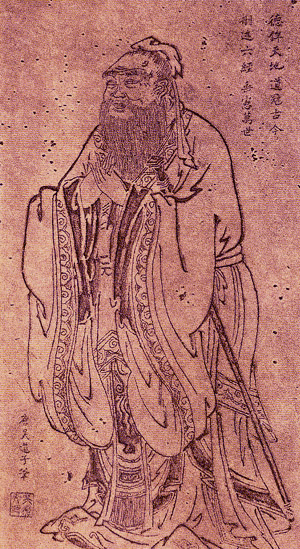
Confucius and Analects


Not that education was not needed for bureaucrats, or general business or in other walks of life. We learn how in China, the  ideas of Confucius  became the basis for training bureaucrats. But they also recognised other aims. Confucius was training bureaucrats two centuries before Plato established his Academy in Athens. The core of his teaching was cultivation of "virtue" which involved piety, reverence leading to a harmonious society. Though born human, we become a person only by fulfilling a responsible role in society and for that cultivation of virtue is essential, not the mere obedience of laws. Confucius said in his Analects:


If people be led by laws, and uniformity  sought to be given them by punishments, they will try to avoid the punishment, but have no sense of shame.
If they be led by virtue, and uniformity sought to be given them by the rules of propriety, they will have the sense of shame, and moreover will become good.

The superior man thinks of virtue; the small man thinks of comfort. The mind of the superior man is conversant with righteousness; the mind of the mean man is conversant with gain.

Thus, we can see that noble minds have been concerned with virtue and righteousness even while training people for political offices. The Greeks and the Romans too held that while happiness was the aim of human life, it was the result of Virtue. In India, this sentiment is expressed in the concept of 'Dharma'. 

Modern trends

All this is a far cry from what modern schooling and colleging  aim at and provide in the name of mass education!

Both the aims and the contents of what is considered education have changed over the centuries. We now have so many 'subjects' and any number of areas for specialisation in each. PHD is the stamp of official approval on the highest level of university education, but it can be on any subject approved by authorities ie those who control the funding and confer the degree. 

Since the early 19th century, "the three r's " - reading, writing, arithmetic- were considered the basic skills to be imparted to  every youngster. They were supplemented by Classics- languages like Greek and Latin and the works of ancient masters. In the last century, education was reformed and modernised. In spite of such efforts, we now have lakhs of school-going Johnnies who cannot read or add!

Tiruvalluvar on education

Tamil poet Tiruvalluvar laid down his definition of education :

கற்க கசடறக் கற்பவை கற்றபின்
நிற்க அதற்குத் தக.                               391

Learn what knowledge is required to be acquired.
Thereafter, conduct your life accordingly.

But what is to be acquired?


எண்ணென்ப ஏனை எழுத்தென்ப  இவ்விரண்டும்
கண்ணென்ப வாழும் உயிர்க்கு.            392

Two are called the eyes of the living: one is called Numbers; the other is called Letters.

கண்ணுடையார் என்பவர் கற்றோர்  முகத்திரண்டு
புண்ணுடையர் கல்லா தவர்.                 393

The learned alone can be said to possess eyes.
The uneducated have only two sores in their face.

ஒருமைக்கண் தாம் கற்ற கல்வி ஒருவர்க்கு
எழுமையும் ஏமாப் புடைத்து.               398

The learning that one acquires in this birth will exalt him in the subsequent seven births.

கேடில் விழுச்செல்வம் கல்வி  ஒருவற்கு
மாடல்ல மற்ற யவை.                         400.

A flawless and imperishable  wealth is the learning one acquires. Others are not wealth at all.

Education and seven births

Here in verse 398, Tiruvalluvar provides serious food for thought. Indian philosophy  and religion are based on rebirth. What merit or demerit one acquires in this birth- his own effort now, here- will shape his future births. The education he acquires now will also influence his future births. This probably accounts for the phenomenon of child prodigies. But will any kind of learning or subject so accompany one for seven births? To day we have hundreds of subjects of specialisation. Are they all relevant for rebirth? Yesterday's Newtonian physics is superseded today. Every branch of science is undergoing such drastic changes. Will they not become irrelevant in the centuries to come? This is the fate of all secular subjects.The kinds of learning that will influence us in future births are what are called the 'eternal verities'- related to the unchanging core of human nature,  the fundamental truths of classical philosophy and religious studies, and not the hundreds of secular subjects, or the speculations of modern philosophers and scientists. This really explains why education was considered 'sacred'. In this one respect, Indian traditional wisdom scores over everything else in the world! However, modern India has already lost sight of this truth.

Reading, conference, writing


In the background of the formal education that prevailed in the 16th/17th centuries, Francis Bacon, contemporary of Shakespeare said:


Reading maketh a full man;
conference a ready man;
and writing an exact man.


Since those times, each of these propositions has become difficult of fulfilment.  Millions of books are in existence, millions more are getting published every year. What to read? Where is the time in these hurly burly days? Even if one is a dedicated practising professional like a lawyer or medical doctor, one cannot hope to fully cope with the new material available. It is said that a research paper in a subject is read by just 3 persons on the average. C.P.Snow said that scientists do not follow the language of humanities, and those in the humanities do not follow the language of science. Smithsonian.com notes:


There are a lot of scientific papers out there. One estimate puts the count at 1.8 million articles published each year, in about 28,000 journals. Who actually reads those papers? According to one 2007 study, not many people: half of academic papers are read only by their authors and journal editors, the study's authors write. 

[Report dated:  March 25, 2014.      Accessed 3 May 2017.]


 So, what can be said of general readership? Most people test their literacy only against newspapers, that too by just skimming it! 

Modern technology has reduced the charm and power of learned conversation. People do not even discuss the weather or politics or cinema. Cell phone, Internet, Facebook etc have killed all meaningful and pleasant conversation.

In the era of instant wireless communication, who writes anything, unless compelled?

It is the absence of all three that is the norm today, especially among youngsters. Almost every youngster is looking into and talking on his cell phone while walking on the road.He doesn't give way to children, seniors. He doesn't address  others properly. Such misbehaviour is a worldwide phenomenon.


Sulking, arguing, lying, and rebelling are just a few of the ways teens misbehave. There's a good explanation for these bad behaviors. As teens become more independent, they still lack the emotional maturity they need to make informed, thoughtful decisions. The parts of the brain that control decision making and impulse control haven't fully developed. The combination of autonomy and immaturity can lead to risky teen behaviors, like drinking, smoking, and having unprotected sex.

[webmd.com  Accessed: 3 May 2017]


A growing lack of adult authority has bred a 'spoilt generation' of children who believe grown-ups must earn their respect, a leading psychologist has warned.
The rise of the 'little emperor' spans the class divide and is fuelling ills from childhood obesity to teenage pregnancy, Aric Sigman's research shows.
Attempts to 'empower' children and a lack of discipline in the classroom have also fostered rising levels of violence, at home, at school and in the street.

dailymail.co.uk. 14 September 2009.

Do we call such 'schooled' youngsters 'educated'?
Traditional education fostered respect for authority, and stressed responsible behaviour. Today, teachers can't discipline the students, nor can parents; such attempts will be construed as violation of some rights!

Education: for what purpose?

With all the hype about modern education, and the hole it puts in the hearts and pockets of parents, there is no clarity as to even the very purpose of education:


What is the purpose of education? The question came into stark relief when Wisconsin Gov. Scott Walker recently tried to quietly change the century-old mission of the University of Wisconsin system by proposing to remove words in the state code that command the university to “search for truth” and "improve the  human condition” and replacing them with “meet the state’s workforce needs.” Walker backed off when the issue became public and sparked intense criticism from academics and others, but the issue remains a topic of national debate 


By Arthur H. Camins
Debate about the purposes of education never seems to end.  Should young people become educated to get prepared to enter the workforce, or should the purpose of education be focused more on social, academic, cultural and intellectual development so that students can grow up to be engaged citizens?
[ Washington Post:  February 12, 2015 ]

Should we not simply say the purpose of education is to make us better human beings , and modern education has failed in this mission? Man is missing in all schemes of modern education!
It was Swami Vivekananda who talked of 'man-making' education!


www,gettingbusy.ch/category/education